

Slots Mechanics
How slot sessions are structured
Slots inside the MCW Casino environment should be read as independent game cycles rather than as a sequence that builds toward a guaranteed event. Every spin is processed separately. The result of one spin does not improve, weaken, or reshape the probability of the next one.
This matters because slot sessions often feel emotional even when the underlying system is not. A near miss may look meaningful. A dry sequence may look like a build-up. A short burst of returns may look like momentum. In practice, these are session impressions, not signals.
RNG remains independent
MCW slot content should be understood through the logic of RNG. The random number generator does not carry memory from prior spins. It does not compensate after losses. It does not increase chances after a cold run. It does not reduce chances after a feature trigger.
That is why language such as “the game is ready to pay” or “a bonus is close” should be avoided. Those phrases describe player perception, not system behaviour. In product terms, the slot remains event-independent across spins.
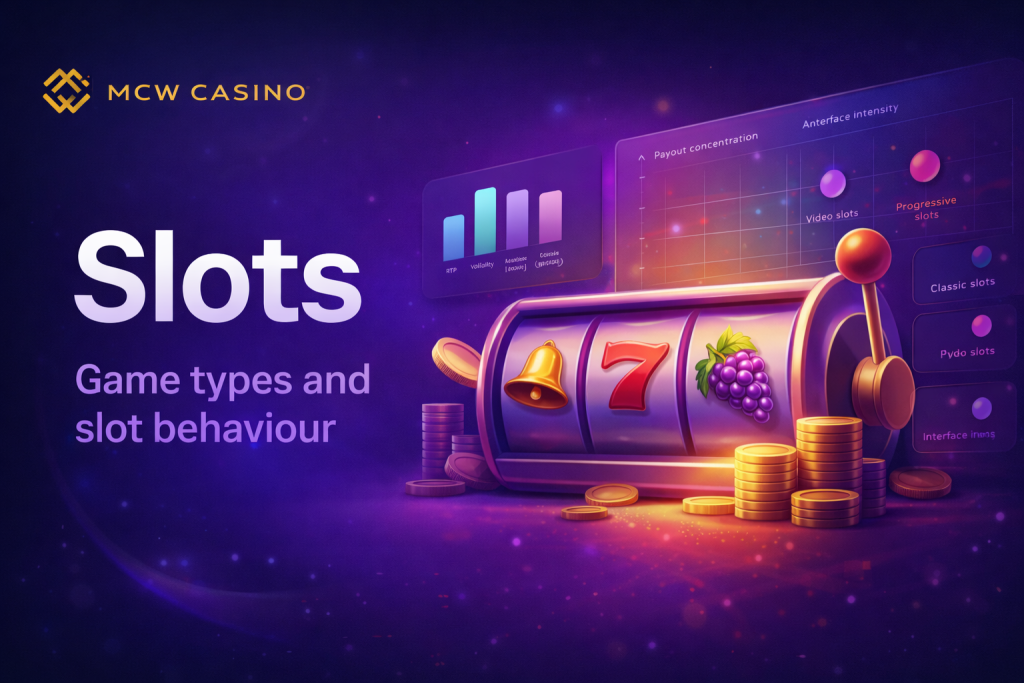
RTP is a long-term distribution model
RTP is useful, but only when read correctly. It is a long-horizon theoretical return model, not a short-session promise. A player may experience a result above or below the displayed RTP during a brief session, and that does not mean the game is malfunctioning.
For slot pages, RTP should be framed as a statistical characteristic of the game design. It helps compare titles at a structural level, but it does not predict the next spin, the next ten spins, or the next bonus round.
Volatility explains spacing, not value
Volatility describes how outcomes are distributed over time. It is not a quality rating and not a profitability indicator. Low-volatility slots usually produce a steadier stream of smaller returns. High-volatility slots usually compress more value into less frequent events.
This is why two games with similar RTP can feel completely different in live play. One may look active and stable across many spins. Another may stay quiet for longer, then concentrate value into rarer moments. The difference is in distribution behaviour, not in a hidden edge.
Demo mode is a reading tool
Demo mode should be treated as a product exploration layer. It is useful for understanding reel speed, feature design, symbol density, bonus rhythm, and interface logic. It helps users read how a slot behaves visually and mechanically.
What it does not do is create a prediction model. Demo play does not reveal when a real-money feature is “due,” and it does not teach a repeatable timing pattern. Its value is structural familiarity, not outcome forecasting.
Core slots model
Slot Categories & Session Reading
How different slot types behave
Slots inside MCW are not one uniform category. They are built across different structural models that change pacing, feature density, and session perception.
Classic slots tend to be simpler. They usually have fewer paylines, fewer feature layers, and a more direct outcome rhythm. Returns appear more frequently, but they are typically smaller in size.
Video slots expand the structure. They introduce multiple paylines, bonus rounds, multipliers, scatters, and layered mechanics. The session becomes more dynamic, with alternating quiet periods and feature-driven spikes.
Progressive slots are structured differently. A portion of each spin contributes to a shared jackpot pool. This changes how value is distributed over time. Most of the return is concentrated into rare events rather than spread across frequent smaller outcomes.
Hit frequency vs payout spacing
Two slots may feel very different even if their RTP is similar. The key difference is how often the slot produces outcomes and how those outcomes are sized.
High hit frequency creates a more active session. The player sees regular returns, which can create a sense of stability. Low hit frequency reduces visible activity but concentrates value into less frequent events.
This is where volatility becomes visible. It is not a hidden advantage or disadvantage. It is a distribution choice.
Feature layers and bonus behaviour
Modern slots often include feature layers such as free spins, expanding symbols, cascading reels, or multipliers. These features do not change the fairness of the game. They change how outcomes are grouped.
A feature round may compress multiple outcomes into a short window. Outside of that, the base game may appear quiet. This contrast is part of the design, not a signal.
Session perception vs system behaviour
Short sessions can feel directional. A sequence of losses may look like a buildup. A sequence of small wins may look like momentum. A sudden feature may look triggered by timing.
In system terms, these are independent events. The slot does not adapt to the session. It does not track player behaviour. It does not modify probabilities based on recent outcomes.
Slot Behaviour Bands
Premium Comparison Layer
How slot categories should be compared
Slot pages work better when categories are compared through structure rather than through hype. The useful question is not which slot type is “better”. The useful question is how each category behaves across pacing, feature pressure, session variance, and jackpot logic.
Classic slots are usually easier to read. Their structure is lighter, the screen is less crowded, and the rhythm is more direct. That does not make them weaker or stronger. It makes them mechanically simpler.
Video slots usually carry more layers. They tend to include more symbols, more feature states, more visual transitions, and more event clustering. The session often feels more active because the interface is doing more work.
Progressive slots should be read carefully. Their structure is not only about the base spin cycle. They also include pooled jackpot logic, which shifts how value can be distributed across the category. This does not create an edge for the player. It changes the shape of rare-event concentration.
Why this comparison table matters
A proper slots table should help a player read differences without creating false expectations. It should explain how a category behaves, where the session pressure comes from, and what kind of pacing to expect.
That is why the table below focuses on behaviour signals:
- rhythm
- variance
- feature weight
- bonus frequency framing
- jackpot presence
- demo utility
- reading complexity
It does not promise outcomes. It does not suggest that one category is smarter to play. It simply helps the page read like an operator product surface rather than an affiliate page.
Premium Slot Comparison Matrix
Analytical Reading Layer
How slot behaviour should be read without hype
A slot page becomes more useful when it helps users interpret structure rather than chase language. That is especially important in categories where visual intensity can easily be mistaken for value.
A fast screen does not automatically mean a stronger game cycle. A feature-rich interface does not automatically mean better session conditions. A jackpot label does not create a more favourable model. These elements change presentation, pacing, and perception, but they do not override the core rules of RNG, RTP, or volatility.
This is why slot reading should stay mechanical.
A player looking at a slot category inside MCW should focus on a few stable questions. How dense is the feature layer. How concentrated are outcomes. How quiet can the base loop become between events. How much session contrast is typical. How much of the category identity comes from interface design rather than from mathematical behaviour.
That framing is more useful than generic ranking language because it keeps attention on how a slot works, not on what it supposedly promises.
Why visual intensity often distorts perception
Modern slot design is built to create rhythm. Symbol motion, audio cues, animated transitions, feature overlays, and bonus teasers all shape the way a session feels. This has value from a UX standpoint, but it can also make the base cycle appear more eventful than it actually is.
That distinction matters. A slot can look busy while still being structurally quiet between meaningful events. It can look generous during small return clusters while still sitting inside a high-variance model. It can feel close to a bonus because of repeated teaser states, even though the next spin remains independent.
For an operator-level page, that difference should be made explicit. The system does not become predictive because the UI becomes expressive.
Reading product fit across slot formats
Different slot formats fit different reading preferences.
Some users want a cleaner reel structure with less interface pressure. Others prefer layered mechanics and more visible transitions between base play and bonus logic. Others are specifically interested in jackpot-linked categories because they want to understand how rare-event concentration changes the session profile.
The point is not to label one category as superior. The point is to explain how the category behaves before the user enters it.
That is where an analytical table is useful. It strips the visual drama away and reduces the category into readable product signals






Comments